Monday, 1 August 2011

Great Things to do in Brazil – The Botanical Gardens, Rio de Janeiro


There are so many places to visit in Rio de Janeiro that the Botanical Gardens often get overlooked, especially by those who don’t have such green fingers. Personally I would recommend it for just about any visitor to the city, and most would find it rewarding. The gardens can be visited in a couple of hours, and combined easily with some of the city’s more famous sights, or perhaps with the Sitio Burle Marx gardens further out of town. On a sultry summer day in Rio, the shade from the tall palms and other assorted trees is more than welcome.


The Botanical Gardens lie between the Rodrigo de Freitas Lagoon and the mountains of the Parque Nacional da Tijuca, which can always be seen through tree trunks and leaves while wandering around, including Corcovado with the statue of Christ the Redeemer almost directly above.


The gardens are now neighboured by the Jockey Club, making the whole area one of the least developed in the city. It was even less developed in 1808, when King João of Portugal decided to inaugurate the gardens, soon after arriving in Brazil to escape a potential revolution at home. The original idea was to have a place for spices to become accustomed to Brazil, as they had after being imported into the Caribbean, with nutmeg, cinnamon and pepper having successfully taken there following introduction from the Spice Islands of Indonesia. Strangely despite the success of the gardens, Brazil still seems to be the only Latin country in the world that doesn’t have black or white pepper on every table.


The gardens were opened to the public in 1822, the same year that João’s son Pedro had declared independence from his returned father’s kingdom. There are now over 6,000 tropical tree and plant species, with the 900 types of palm being possibly the most spectacular, including the centre-piece Avenue of Royal Palms, and the incredible colours of the Pau Mulatto trees This Amazon spruce sheds its bark completely between July and September, the bark being one of those used in Ayahuasca rituals, and the colours of the smooth trunk include bronze,  green, orange and purple. The sight of the whole alley of pau mulattos in their annual Carnaval parade makes you wonder if you actually drank some ayahuasca before arriving at the gardens.


The other essential tree to look out for is the pau brasil. This is the tree that is responsible for the whole of Brazil. Or for the name at least. The Portuguese explorers found the tree with its red resin being useful for dyes. It grew in the Atlantic Rainforest from Rio de Janeiro up to Rio Grande do Norte, including most of the original areas that the colonialists went ashore. The Portuguese cut down this 15m tall tree in thousands and thousands, shipping them off for sale in Europe in order to pay off debts to the English government of the time. They were the original reason for colonisation, before the sugar and coffee plantations had even been considered.


The Rio de Janeiro Botanical Gardens also boasts an impressive Bromeliário and a colourful Orquidário, as well as houses for carnivorous and cacti plants, the Sensorial Garden, and also the Fountain of the Muses focal point. Waterfalls and trails through the Atlantic Rainforest  keep the scenery interesting, while the local wildlife colours the trees and grasses, and would hold the attention of young children, at least for a while! The turtles climbing over each other to catch some sun at the entrance are supplemented by enormous carp in the ponds. Visits from monkeys are common, including the cute tuft-eared marmosets, and the less cute howler monkeys - renowned for their piercing grunts, and also for throwing their faeces at other creatures that invade their personal space.

Hundreds of bird species can be found too, including the vivid colours of parakeets, macaws, humming-birds (the more poetic beija-flor in Portuguese – the Flower-Kisser) and many different types of toucan. They are generally quite small compared to their Amazon and Pantanal cousins, but the yellow-breasted or black-beaked toucans, and the classical tucanuçu are numerous in the gardens, flying from tree to tree for berries. Sightings of these wonderful birds and others are far more common in the gardens than outside, as they have become accustomed to the presence of humans over the years, and do not fly off quite so readily as in the forests. Their habit of taking flight at regular intervals, just as you have your camera set on them amongst the foliage, only makes them even more loveable. Personally, I think the toucans are worth the bargain R$6 entrance fee on their own, even if the gardens themselves might not appeal.

They should though. The Rio de Janeiro Botanical Gardens are one of the most impressive in Brazil, South America or anywhere else, and should definitely be on the list of Things To Do in Brazil.

Sunday, 31 July 2011

The Rio de Janeiro Marathon


The Rio de Janeiro Marathon is a great way to see a great city. It includes parts that some visitors may never otherwise visit, and the marathon route certainly takes in roads of the city that would be suicide for a pedestrian on any other day.

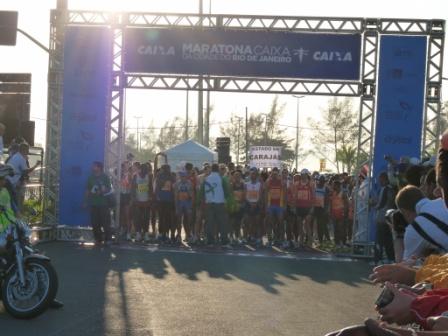
The marathon begins in the far east of Rio, at Praia do Pontal, the edge of the city before the nature reserves of Prainha and Grumari. From there, the route takes you all along the Atlantic shoreline of Rio, with just a few tunnels  to pound through between the different beaches until the Finish Line at Flamengo. There are also the Half Marathon and the Family Run participants, with a total of around 10,000 runners in all on the middle Sunday in July.

There may have been less though. With some classic Brazilian organisation, the Family Run changed date with only five days to go. Perhaps closing these roads on two separate days was deemed too sophisticated an undertaking, as it certainly wasn’t done properly that one time either.

The Start Line especially was a Triumph of Brazilian Organisation, with the starting gate sending runners away from the city for the first 1.5km, around the corner at Praia da Macumba and back along the very same stretch, separated by barriers in the middle of the road. This gives a wonderful close-up view of the elite athletes, a little group of little East Africans and assorted other runners, all sprinting for the line as though the Starting Gate were the end of the race, not just something that they would soon pass under once more with another 40km remaining.

The barriers separating the two sides disappear well before the start line, and this being Brazil, half the runners arrived after the 7.30am starting gun. This means that the Rio Marathon could well be the only marathon in the world where some people start the race with the genuine danger of being run over by potential winners. You can’t say that about many sporting events!


I was actually passed by somebody running far too fast to be anywhere near me, so I guessed that he must have been a local lad with local time-keeping. This was somewhere along the Praia da Reserva section, closed to traffic, and nice and peaceful, with only waves for company. Entering Barra da Tijuca, this changed quite quickly, and really makes me wonder about Rio’s ability to organise a whole Olympics. With two lanes on each side of the road, and parking spaces between them too, you would think that the obvious answer would be to close one half for the marathon runners only, and split the other half into one lane each way. It would only be necessary for a couple of early Sunday morning hours until all the runners had passed.

Brazil doesn’t like the obvious solution. The beach side was split in half, with cones and tape to separate thousands of runners from hundreds of passing Carioca drivers, some trying find parking spaces for their day at the beach, others blasting their horns behind at being delayed for ten seconds. You all know how it is. Again, the Rio Marathon must be the only one where there is a genuine danger of being run over while actually on the course, by an aggressive driver deciding to cut through the cones instead of letting somebody park in peace. The shouts of porra and filha da p... filled the fresh morning air.


Still, the best part was yet to come. The buses still pass down that lane too of course, and one stopped ahead of me. Three bewildered passengers descended just in front, trapped between tape and bus, and with a road full of runners right in front of their eyes. They were trying to edge into the middle of the race, having nowhere else to go, trouble in front and behind, coitados. It was like an Alpine stage of the Tour de France if it had far more cyclists than spectators. I ran past laughing and resolved to stick to the beira-mar side of the lane.

The tunnels through Pedra da Gavea to Sao Conrado, and the exciting Elevado do Joá were all great fun. Only runners, some shouting through the tunnels, a lovely breeze over the turquoise sea, and a classical music and laser disco for company. I didn’t expect that.

Av. Niemeyer, the road that hugs the hillside around the coast to Leblon, was also good fun, especially for the long-boarder who was using the open half for some quality long skating down the hill. Leblon, Ipanema and Copacabana are the parts where things begin to hurt a little, the run becomes a trudge, and there are more people crossing to the beach than running as the field spreads out. Lots of people clapping, lots of encouragement, which really does help immensely at that stage. Except the well-meaning Carioca shouting ‘Vamos Argentino’ at me outside the Copacabana Palace. Why do some Brazilians think that all foreigners must be Argentinean? Or perhaps from the USA once they know that you speak English. The best mullet in the world couldn’t make me look Argentinean.

The final tunnels through to Botafogo and one more curve before the very welcome Finish Line in the shadow of Sugar Loaf, and a medal given under the gaze of Cristo. Wonderful.


A great place to end a great race. The only thing left to do was to relax in the shade of a tree and watch the medal ceremonies. Some more great organisational comedy, as the winner of the Women’s Marathon, Kum Ok Kim, had to suffer the ignominy of having no national anthem of North Korea to accompany her flag. No doubt somebody at this point was running around record shops in Rio, desperately trying to find a National Anthems CD, or to download one as quickly as possible. Ms Kim had to return later, alone, to hear her country’s anthem. Now bearing in mind that only 16 ladies finished in under 3 hours, you would think that the field of possible winners was limited enough to be prepared for the eventuality of one of the foreign winners requiring an anthem... Or perhaps to have a stock of them all.


As with all Big City marathons, the Rio de Janeiro Marathon should showcase the best sights of the city, and this beach-side run is definitely as good as anything in the world. I’ll go again in 2012, maybe take things a bit more seriously this time. I’ve got a Personal Best to beat now in the Rio de Janeiro Marathon. If I beat it by an hour and a half or more, I expect to be standing proudly on the Winner’s Podium saluting the flag as they play the national anthem of Argentina.

Thursday, 3 February 2011

Personal Safety & Security While Travelling in Brazil

Visitors to Brazil are often scared of the reputation that the country has in terms of personal safety and security. Much of this reputation has been earned of course, but in the days of 24 hour rolling news channels and worldwide internet coverage, there is also a tendency to dramatise dangers, and Brazil is no different to anywhere else in this respect.

Some people arrive in Brazil expecting civil war in the streets, and to not be able to leave their hotels at night for fear of violence, but then arrive to find people strolling in the streets, eating dinner outside and laughing and joking as if the civil war never existed. With it didn’t. Even the recent trouble around Penha in the Zona Norte of Rio de Janeiro, with tanks and armoured cars travelling up the streets and drug-traffickers escaping Vila Cruzeiro for the Complexo do Alemão, even this didn’t affect most of the rest of the city too much, never mind the rest of Brazil. Life continued as normal for most people, and tourists in the city didn’t seem to notice the supposed civil war as they went to watch Bossa Nova bands on the Saturday night.

This is not to say that Brazil is a trouble-free country of course, and it never will be while such a huge gap between rich and poor continues to exist. Visiting foreigners will always be seen as rich by most Brazilians, and even the most hard-up, spent-up backpacker will still be comparatively wealthy by local standards, and may be a target for those locals who need some quick money and are prepared to use violence or the threat of it.